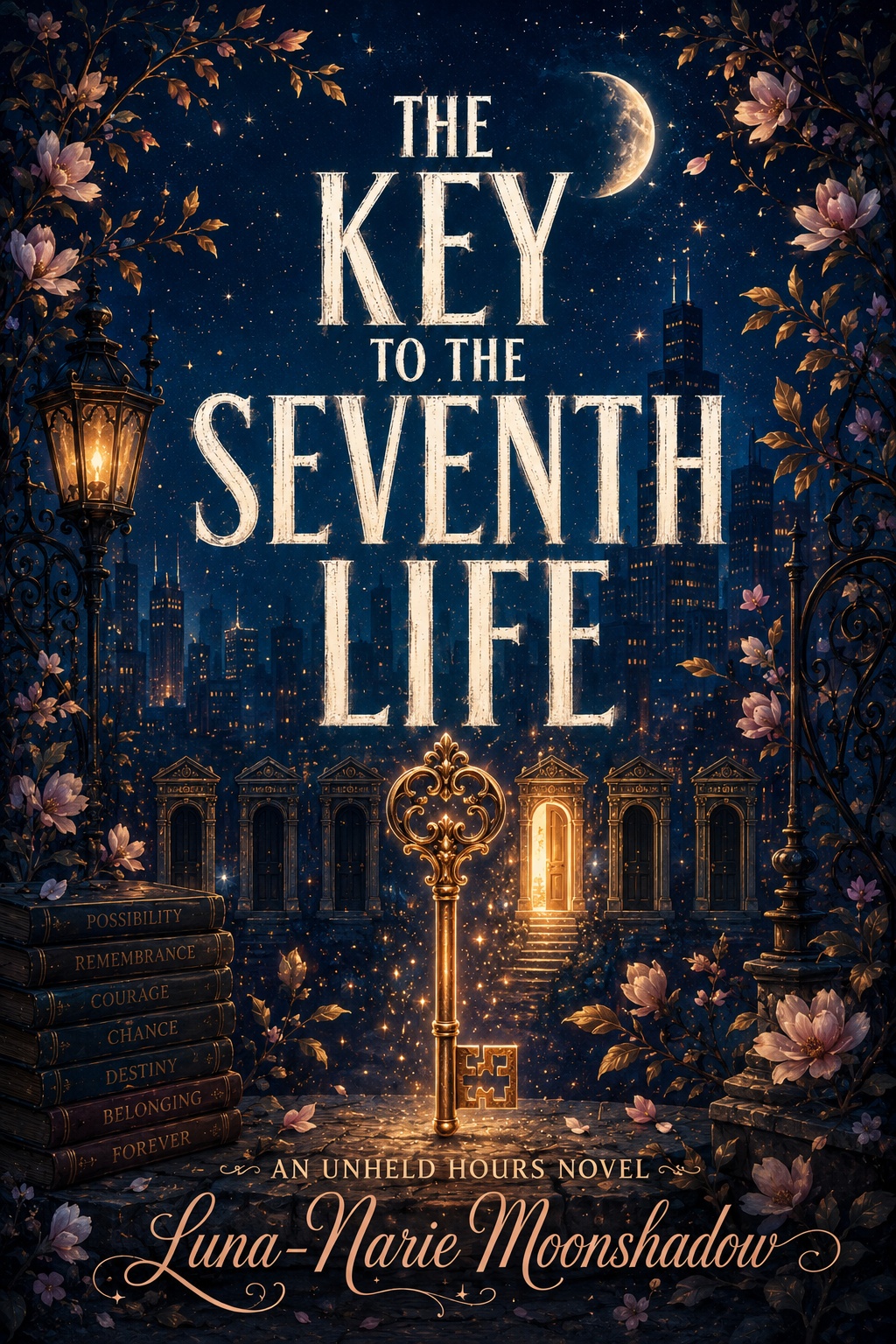
By the time I reached The Key to the Seventh Life, the world of The Unheld Hours had begun to reveal its larger shape.
The first books had opened questions about memory and unlived futures. The third asked a different question: how many selves can one person become without losing the thread of who they are?
We often speak about identity as though it is a single object waiting to be discovered. But a life is rarely that tidy. We are shaped by what we survive, what we choose, what we inherit, what we release, and what we finally permit ourselves to want.
The key became a symbol of access, but not possession. A key may open a room, a history, or a version of the self. It does not guarantee that the person entering will recognize what waits inside.
The idea of a seventh life allowed me to explore identity as a sequence rather than a verdict. The earlier selves are not necessarily false. They may have been necessary. They may have protected us, carried responsibilities, loved imperfectly, or endured what the next self could not yet imagine.
Transformation does not erase those earlier lives. It places them in relationship with the person we are becoming.
This book also emerged from my belief that no stage of life is final. A private decision can rearrange someone completely. From the outside, the change may appear small: a door opened, a truth spoken, a boundary established, a return refused. Internally, an entire life may be ending while another begins.
The key therefore represents permission as much as access. Sometimes we wait for permission from family, history, tradition, or the person we used to be. We assume the next life cannot begin until the previous one approves.
But becoming rarely works that way.
The person we are becoming may need to disappoint an earlier version of ourselves. She may need to abandon an old promise, not because it was meaningless, but because it belonged to a life that can no longer hold her.
Writing this book helped me understand that the series was not only about extraordinary places. It was about the threshold itself: the moment a character realizes that continuing unchanged is also a choice.
The seventh life is not necessarily the final or perfected self. It is simply the life waiting beyond the door that can now be opened.
The key does not create courage. It reveals that the lock was never the only thing keeping the door closed.
A Simple Coffee Spell for Trusting The Self That Is Still Becoming
This gentle intention ritual uses exactly three everyday pantry ingredients. It is not a promise of a particular outcome. Its purpose is to pause, focus your attention, and choose how you want to meet the day.
Three ingredients
- 1 cup brewed coffee
- A small pinch of nutmeg
- Milk or cream, optional
Optional ritual tools
These are not ingredients and are not required.
- One white tealight candle
- One tiger's eye crystal, or any small stone that feels meaningful
- A notebook or scrap of paper
The ritual
Prepare your coffee as you normally would. Add each ingredient slowly, giving it a simple meaning as it enters the cup.
As you stir, say:
I do not need to see the entire path.
I choose the next honest step.
What is mine to carry will become clear through attention.
If using a white tealight, light it before drinking and let it represent clarity rather than certainty. If using a crystal, place it beside the cup as a physical reminder of your intention. Neither is required.
Take three unhurried sips. After the third, write one sentence beginning with:
Today, I will give my attention to...
Keep the sentence small enough to live rather than merely admire.
Pantry-magic note
The three ingredients are symbolic, not prescriptive. You may substitute an equivalent pantry item, but keep the finished spell to exactly three ingredients. The ritual belongs to the attention you bring, not to perfect supplies.