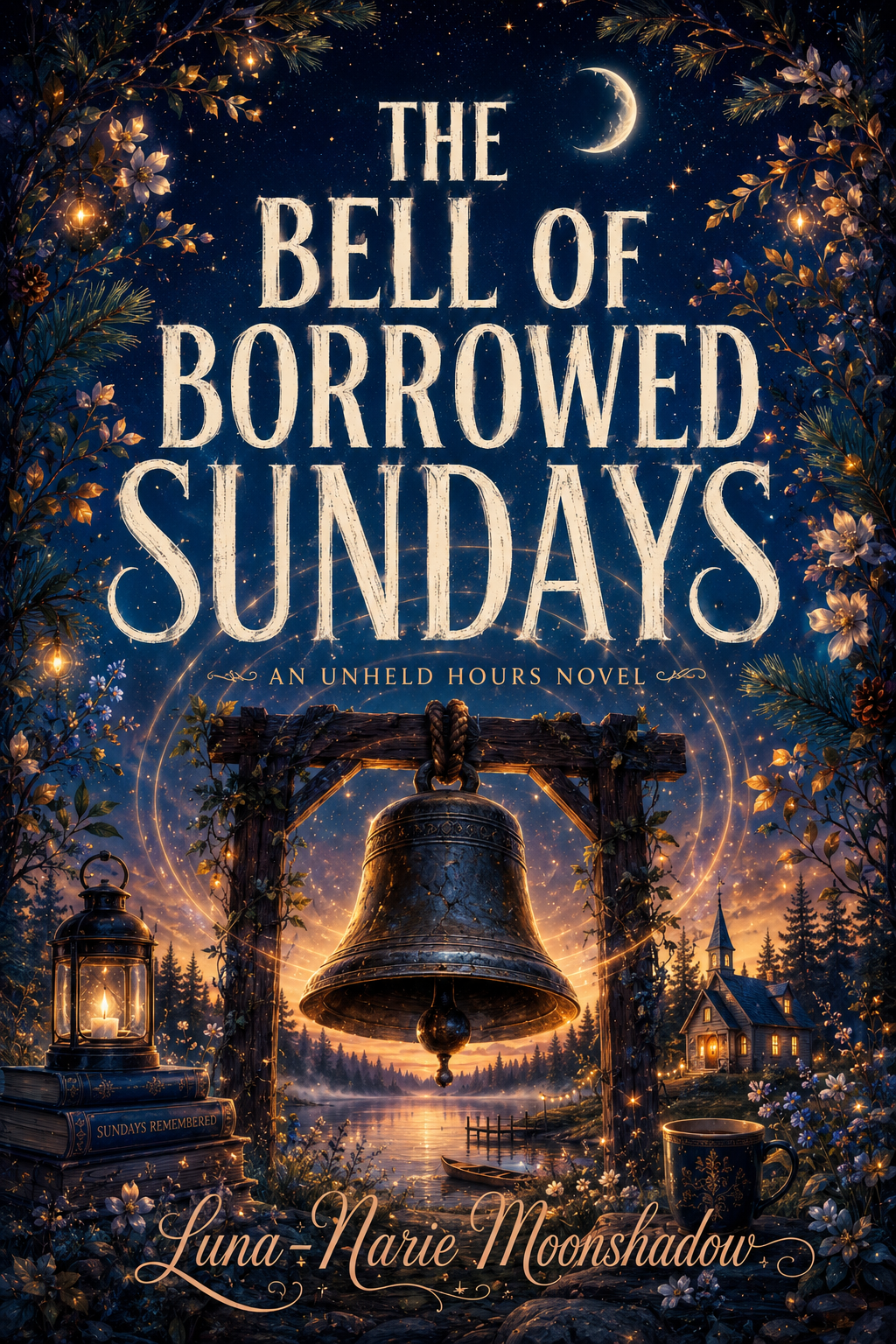
A Sunday can be a day, a memory, a promise, or a feeling.
The Bell of Borrowed Sundays began with the emotional weight of rest. Not rest as an empty space between obligations, but rest as something many people struggle to receive without guilt.
For those shaped by responsibility, caregiving, work, family expectation, or survival, rest may feel borrowed. It may seem temporarily permitted, always subject to interruption, and never fully owned.
The bell became the sound of that permission.
I imagined a place where Sundays could be borrowed, revisited, or held beyond their proper time. The magic offered relief, but the cost lived beneath the relief. What happens when a person repeatedly escapes into the one day that asks nothing of them? What happens when borrowed peace begins to replace the life that still requires a conscious choice?
This book allowed me to explore the difference between restoration and disappearance.
Restoration returns us to ourselves. Disappearance removes us from the demands of being ourselves. From a distance, the two may look identical. The difference is discovered when it is time to return.
The title also carries nostalgia. Many people remember Sundays through family rituals, food, music, church, quiet streets, closed shops, or the particular light of an afternoon that seemed longer in childhood. Those memories can feel sacred even when the past surrounding them was complicated.
As with every book in the series, more than one truth can exist at once. A remembered Sunday may have held comfort for one person and confinement for another. Nostalgia can preserve tenderness while softening the edges of what was difficult.
The borrowed Sunday therefore cannot be treated as a perfect refuge. It is a place where the character must ask what they are actually seeking: rest, belonging, escape, absolution, or the illusion that time can be paused before another loss arrives.
Writing the book reminded me that rest should not always require justification. We do not need to collapse before we are permitted to stop. We do not need to finish every task before we are allowed to become quiet.
But rest becomes most meaningful when it helps us return to the present rather than avoid it indefinitely.
The bell rings because time continues. Its sound is not only an ending. It is an invitation to carry something restorative back across the threshold.
A borrowed Sunday cannot last forever. The deeper question is whether one peaceful day can teach us to build a life in which rest no longer feels stolen.
A Simple Tea Spell for Making Room For Rest Without Earning It First
This gentle intention ritual uses exactly three everyday pantry ingredients. It is not a promise of a particular outcome. Its purpose is to pause, focus your attention, and choose how you want to meet the day.
Three ingredients
- 1 cup tea of choice
- 1 teaspoon honey
- A pinch of cinnamon, optional
Optional ritual tools
These are not ingredients and are not required.
- One white tealight candle
- One rose quartz crystal, or any small stone that feels meaningful
- A notebook or scrap of paper
The ritual
Prepare your tea as you normally would. Add each ingredient slowly, giving it a simple meaning as it enters the cup.
As you stir, say:
I do not need to see the entire path.
I choose the next honest step.
What is mine to carry will become clear through attention.
If using a white tealight, light it before drinking and let it represent clarity rather than certainty. If using a crystal, place it beside the cup as a physical reminder of your intention. Neither is required.
Take three unhurried sips. After the third, write one sentence beginning with:
Today, I will give my attention to...
Keep the sentence small enough to live rather than merely admire.
Pantry-magic note
The three ingredients are symbolic, not prescriptive. You may substitute an equivalent pantry item, but keep the finished spell to exactly three ingredients. The ritual belongs to the attention you bring, not to perfect supplies.