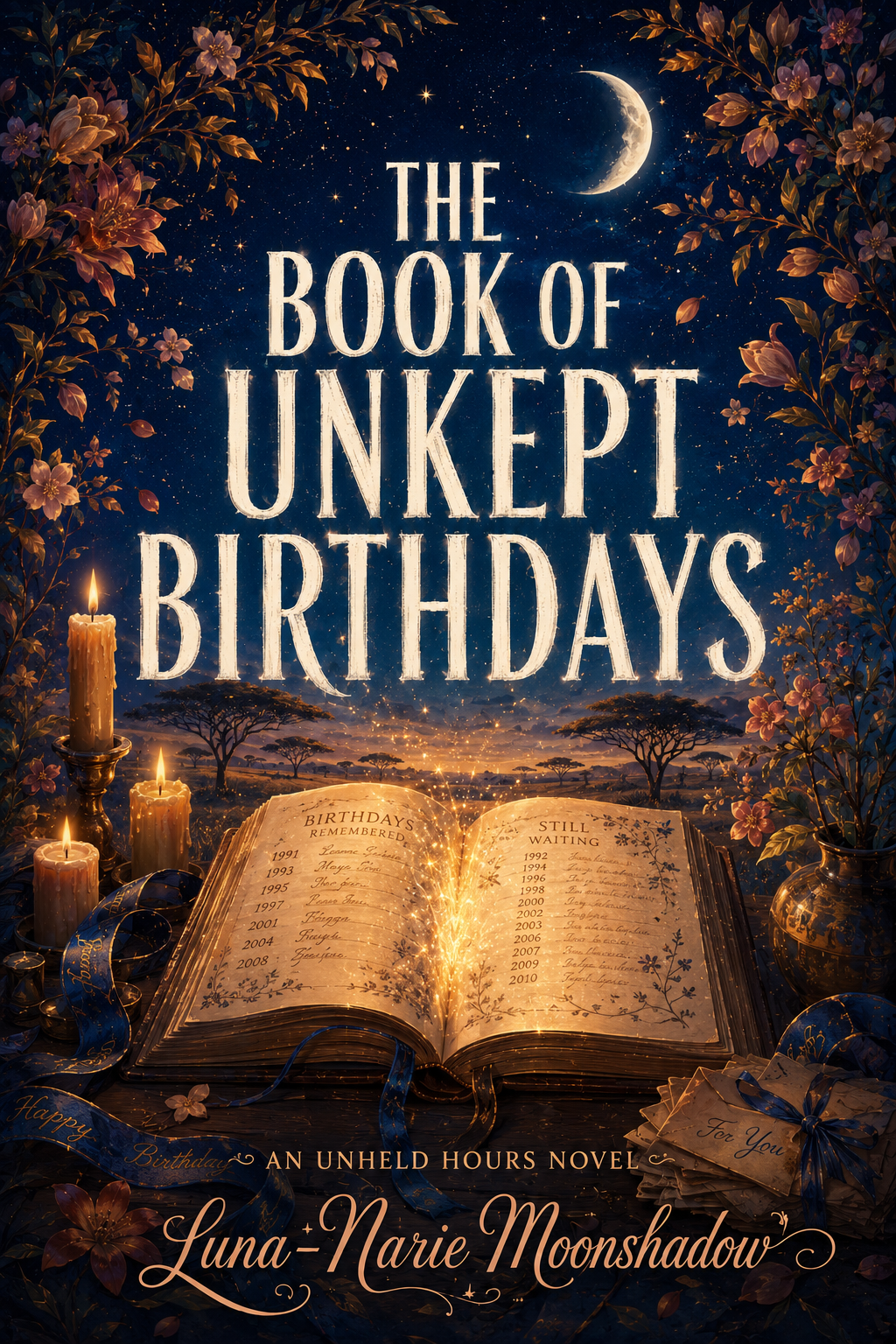
A birthday is both a date and a witness.
It says: you arrived, another year passed, and your life deserves to be marked.
The Book of Unkept Birthdays began with the years that pass without being fully witnessed. Some birthdays are forgotten by others. Some are deliberately ignored. Some arrive during grief, illness, caregiving, financial strain, or a season in which celebration feels impossible.
The date still passes.
The person still changes.
I imagined a book that kept the birthdays no one else held. It would preserve not only dates, but the unlived celebrations, unspoken wishes, and versions of the self that received no ceremony.
That magical object opened a larger question about recognition. How much of our identity depends on being witnessed? What happens to the years when no one reflects us back to ourselves?
The book became especially connected to invisible labor and quiet endurance. A person may spend years sustaining everyone else while her own milestones pass like unmarked exits along a road.
She may later believe those years were empty because they produced no public celebration.
But an uncelebrated year is not an unlived year.
The magical book can reveal what occurred, what was sacrificed, and what the person became. It cannot retroactively create the exact recognition that was missing. That absence remains part of the truth.
Healing here is not perfect restoration. It is the decision to recognize the life that continued.
Writing this novel helped me think about ritual in a simple way. A ritual does not need to be elaborate to matter. Lighting a candle, making a favorite drink, writing one sentence, or naming what changed can become an act of witness.
The value lies in attention.
The Book of Unkept Birthdays is therefore not only about celebration. It is about refusing to treat unwitnessed years as disposable.
Every year contains a self who carried something forward. She may have survived, learned, released, protected, created, or simply continued. Those acts deserve acknowledgment even when no one placed candles on a cake.
The book asks the character to stop waiting for the past to provide the celebration it failed to give. The present can become a witness.
We cannot relive every forgotten birthday. We can decide that the person who lived through them will no longer remain unseen.
A Simple Tea Spell for Recognizing The Life That Continued Even When It Went Uncelebrated
This gentle intention ritual uses exactly three everyday pantry ingredients. It is not a promise of a particular outcome. Its purpose is to pause, focus your attention, and choose how you want to meet the day.
Three ingredients
- 1 cup tea of choice
- 1 teaspoon sugar or honey
- A drop of vanilla extract, optional
Optional ritual tools
These are not ingredients and are not required.
- One white tealight candle
- One carnelian crystal, or any small stone that feels meaningful
- A notebook or scrap of paper
The ritual
Prepare your tea as you normally would. Add each ingredient slowly, giving it a simple meaning as it enters the cup.
As you stir, say:
I do not need to see the entire path.
I choose the next honest step.
What is mine to carry will become clear through attention.
If using a white tealight, light it before drinking and let it represent clarity rather than certainty. If using a crystal, place it beside the cup as a physical reminder of your intention. Neither is required.
Take three unhurried sips. After the third, write one sentence beginning with:
Today, I will give my attention to...
Keep the sentence small enough to live rather than merely admire.
Pantry-magic note
The three ingredients are symbolic, not prescriptive. You may substitute an equivalent pantry item, but keep the finished spell to exactly three ingredients. The ritual belongs to the attention you bring, not to perfect supplies.